GRIDS Regional Twinning/Training Programme for capacity and trust building, networking and actionable intelligence sharing for customs and postal security officers in West and Central Africa
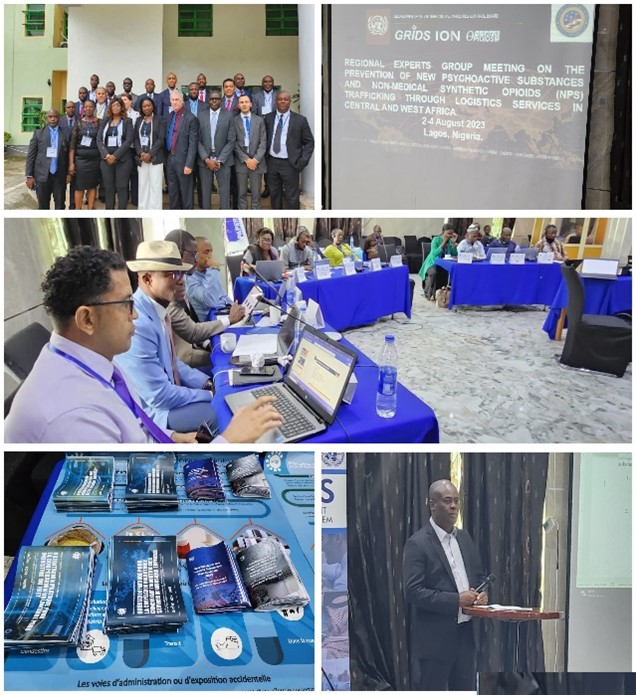
Lagos, Nigeria, 2-4 August 2023 - The International Narcotics Control Board (INCB) Global Rapid Interdiction of Dangerous Substances (GRIDS) Programme organized a 3-day regional expert group meeting on the Prevention of New Psychoactive Substances (NPS) and non-medical synthetic opioids trafficking through logistics services in Central and West Africa. Through presentations and subsequent discussion, the 18 experts from logistics related services operating in Central and West Africa, governments and international organizations shared their experiences in addressing increasing trafficking of NPS and non-medical synthetic opioids.
In the first day morning, experts from governments and international organizations presented prevalence and trafficking trends of NPS and nonmedical synthetic opioids in the regions of Central and West Africa. The speakers were from the National Drug Law Enforcement Agency (NDLEA) of Nigeria, the National Agency of Food and Drug Administration and Control (NAFDAC) of Nigeria, the National Control Commission (NCC) of Ghana, l'Office Central pour la Répression du Trafic Illicite des Stupéfiants (OCTRIS) of Senegal, WCO Regional Intelligence and Liaison Office (WCO-RILO) West Africa, the International Air Transport Association (IATA).
In the first day afternoon, the Universal Postal Union (UPU) regional postal security manager for West and Central Africa and an expert from CONGO POST, the postal service of the Republic of Congo (Brazzaville), as well as private sector experts from DHL Nigeria and l'Association des Distributeurs de Colis Express (ADICE), a local association of small-scale logistic service providers utilizing extra space of air passengers' personal luggage based in Senegal, discussed how to prevent the misuse of postal / courier services for the purpose of NPS trafficking through showing typical modalities of misuse and sharing their respective experiences based on real cases including how they have established voluntary cooperation schemes between governments and postal/courier service providers.
On the second day, the participants continued discussion on how to prevent dangerous substance trafficking through voluntary cooperation between governments and private sector. WCO-RILO Central Africa and the customs of Congo (Brazzaville) shared the public sector's perspectives, while Africa Global Logistics (AGL) from Côte d'Ivoire, Nigerian Aviation Handling Company (NAHCO) from Nigeria, AviSecure (a security service company) from Côte d'Ivoire, and Aviance Ghana shared the private sector's views and practices to prevent misuse of air freight, passenger luggage and other non-freight packages.
The last day the participants adopted 14 practical recommendations for governments, the private sector, and international organizations including INCB to prevent dangerous substance trafficking through the promotion of public-private partnerships.
The Board's Global Rapid Interdiction of Dangerous Substances (GRIDS) Programme and Project ION and OPIOIDS Project support Governments' capacity to respond to changing trafficking, illicit manufacture, marketing and sales of NPS, non-medical synthetic opioids and fentanyl-related substances by providing real-time communication, facilitating information exchange and intelligence development that interdict distribution of dangerous substances.
The GRIDS Programme is supported by the Governments of Canada, Japan and the United States. This event was made possible through generous support from the Government of United States and technical support from UNODC Nigeria.
Click here to learn more about the GRIDS Programme
Click here to learn more about the OPIOIDS Project
Click here to learn more about the Project ION