In recent years, voluntary public-private partnerships have come to play an increasingly important role in global precursor control. In this context, the concept aims at preventing the diversion of chemicals for illicit purposes, through cooperation between national authorities and the private sector. INCB has further expanded its public-private partnerships to include legitimate e-commerce and B2B operators, marketing and social media, online financial service providers, and express mail and courier services. It is important to note that these voluntary partnerships supplement the obligatory controls prescribed by the United Nations Convention against Illicit Traffic in Narcotic Drugs and Psychotropic Substances of 1988.
|
Article 12, Para 9a, 1988 Convention: Each Party shall "establish and maintain a system to monitor international trade in substances in Table I and Table II in order to facilitate the identification of suspicious transactions. Such monitoring systems shall be applied in close co-operation with manufacturers, importers, exporters, wholesalers and retailers, who shall inform the competent authorities of suspicious orders and transactions". |
Effective public-private partnerships have become essential as drug traffickers' modi operandi to source chemicals needed for illicit purposes, especially for illicit drug manufacture, have changed. Often, diversion is no longer occurring from international trade, but drug traffickers are increasingly exploiting vulnerabilities in domestic trade and distribution to obtain the chemicals. The new sourcing method as well as the nearly infinite number of non-scheduled substances that could be used to replace controlled precursors pose a significant challenge to many Governments.
Legislative changes provide long-term solutions, but their enforcement and administration are in most cases resource-intensive. As most commercial transactions involving chemicals are legitimate and conducted by bona fide companies, additional legislative controls could potentially also place an unnecessary administrative burden on the public and private sectors.
This is where strategies based on voluntary public-private partnerships constitute an invaluable supplement to the obligatory controls. The partnerships provide a number of tangible benefits to both the public and the private sector. Through their speed of response and flexibility, they effectively address misuse of non-scheduled chemicals as well as diversion and trafficking at the domestic level.
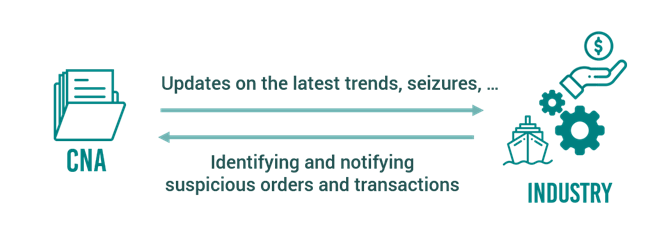
The 1988 Convention requires parties to establish and maintain a system to monitor international trade in substances scheduled in Table I and Table II, in close cooperation with manufacturers, importers, exporters, wholesalers and retailers. However, the concept has not yet been implemented to its full potential. Even in countries with a long history of cooperation with industry, there is room to improve cooperation at lower levels of the distribution chain as well as in relation to non-scheduled and custom-made chemicals ("designer precursors").
This was recognised by the Outcome Document of the 2016 UN Special Session on the World Drug Problem, which also noted the important role of partnerships as well as the INCB in addressing the diversion of precursors.
|
Article 5c of the 2016 UN Special Session on the World Drug Problem recommends Governments to "establish and strengthen partnerships and information exchange with industries, in particular with chemical and pharmaceutical industries and other relevant private sector entities, and encourage the use of the Guidelines for a Voluntary Code of Practice for the Chemical Industry, issued by the International Narcotics Control Board, and the Board's model memorandum of understanding between Governments and private sector partners, as and where appropriate, bearing in mind the important role these industries can play in addressing and countering the world drug problem". |
The INCB, through its PUBLIC-PRIVATE PARTNERSHIPS Project, supports Governments in developing and implementing voluntary partnerships as an effective strategy to prevent the diversion of chemicals.
Public-Private Partnership initiative is one of three pillars - along with Project ION and the Global Opioids Project- of the Global Rapid Interdiction of Dangerous Substances (GRIDS) Programme launched by the Board in 2019.
|
|
|